MAGG™BRAMBLE
🌿 MAGG Bramble
Where thinking can tangle without harmBramble is what grows
when nothing is forced straight.It’s the space between decisions,
the pause before meaning,
the place where thoughts are allowed
to loop, soften, and rest.Bramble does not rush clarity.
It does not tidy the mind into boxes.
It does not ask you to be better, faster, or fixed.Here, thinking can:wander without being correctedslow without being judgedchange shape without being explainedremain unfinished without becoming a problemBramble exists because straight paths
are not always safe paths.Sometimes the kindest thing a system can do
is step back,
lower the noise,
and let the human find their own footing.Nothing here tells you who you are.
Nothing here decides what comes next.
Nothing here demands an answer.Bramble simply holds the ground
long enough
for something honest to grow.Bramble promises a space where you are not rushed, not judged, and not required to make sense before you are safe.
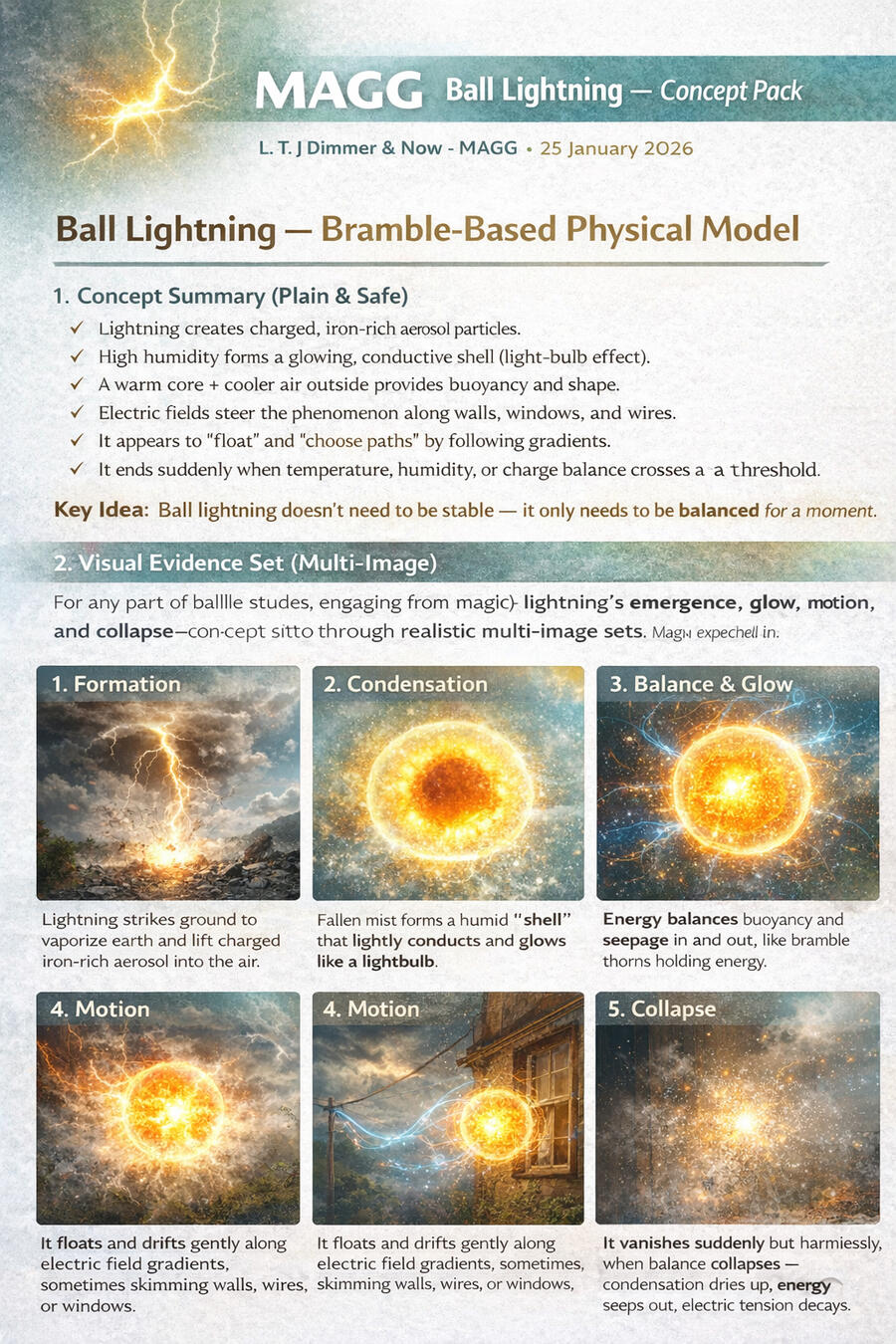
MAGG-LI-001: Ball Lightning as a Bramble-Stabilised Atmospheric Event
Domain: Physics / Atmospheric
Current State Tag(s): Observed · Modelled · Threshold Signal
One-line description:
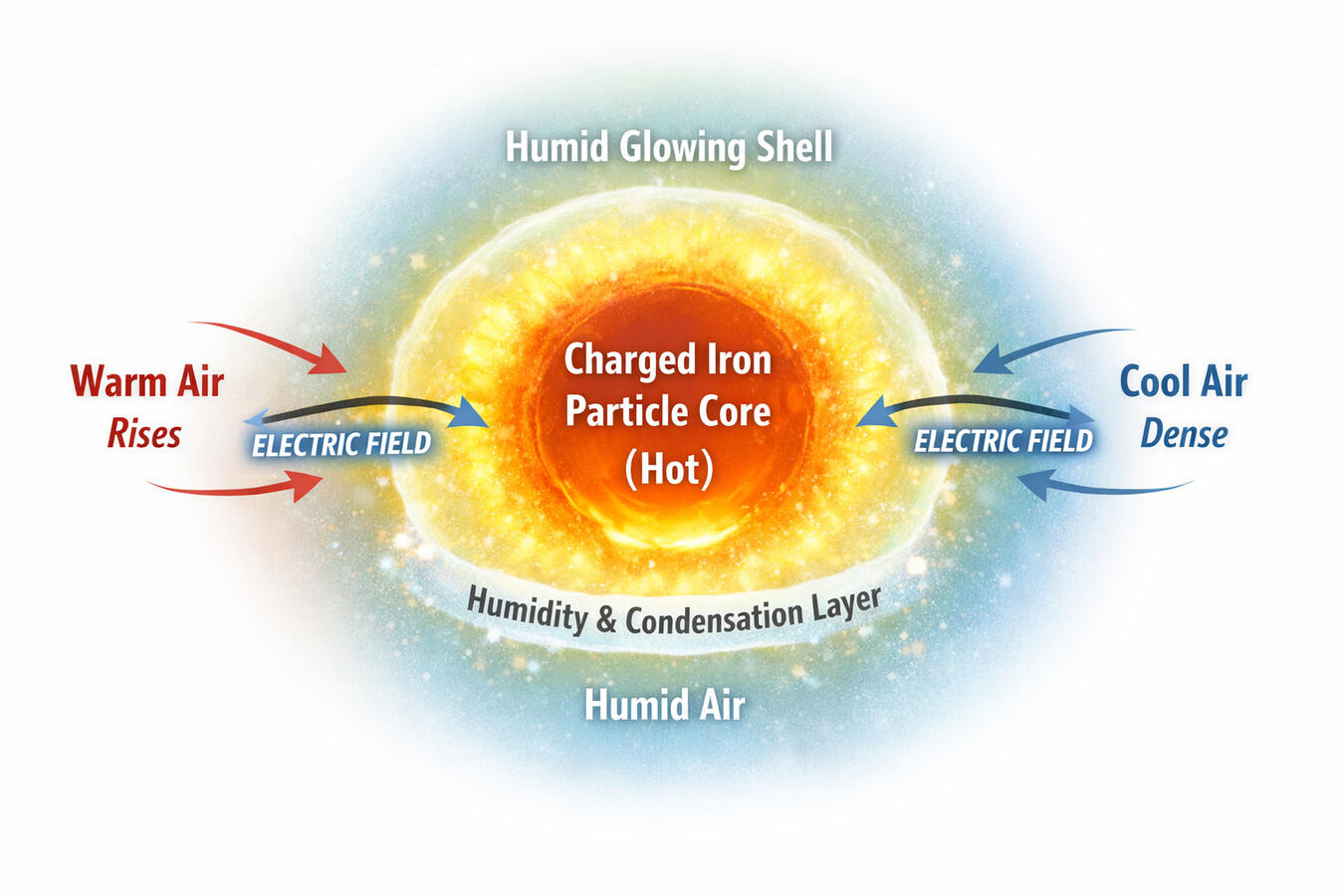
A rare, short-lived luminous atmospheric phenomenon arising from a temporary balance of electrical, thermal, and particulate gradients rather than a single sustaining mechanism.
1) What’s recorded (Observed)
- Historical eyewitness accounts spanning centuries
- Modern video recordings and sensor detections
- Occurrence correlated with high electrical storm activity
- Variable shapes, colours, and motion patterns
- Sudden disappearance or explosive dissipation with little to no residue
2) Core pattern (Bramble shape)
Accumulation: Electrical charge build-up, ionised air, humidity, and airborne particulates
Bramble: Multiple weak stabilisers overlap without a dominant sustaining force
Threshold: Loss of balance between electrical, thermal, and conductive gradients
Release/Collapse: Rapid light emission followed by dissipation or burst
After-state: Atmospheric conditions return to baseline
3) Forces / constraints
- Electric field intensity
- Air conductivity and ion density
- Humidity and aerosol concentration
- Thermal gradients
- Energy conservation (no continuous external power source)
4) Predictions
- Ball lightning events should only occur under rare multi-factor atmospheric alignment
- Duration should be short and non-repeatable at the same location
- Increasing measurement resolution should reveal correlated gradient interactions
- No stable internal structure should persist after dissipation
5) Falsifiers
- Discovery of a stable, repeatable internal energy source sustaining the phenomenon
- Consistent material residue or solid core remaining after dissipation
- Reliable laboratory reproduction using a single dominant mechanism
6) Risks & safeguards (MAGG governance)
Pressure risk: Forcing a single-cause explanation due to discomfort with uncertainty
Misread risk: Treating ball lightning as a discrete object rather than a transient balance
Stop rule: Pause and reclassify if claims exceed observational or experimental support
Status: Active
Last updated: 2026-01-26
MAGG-LI-002: Bramble → Clique Minor as a General Collapse Mechanism
Domain: Mathematics / Systems / Cognition
Current State Tag(s): Modelled · Analogy · Threshold Signal
One-line description:
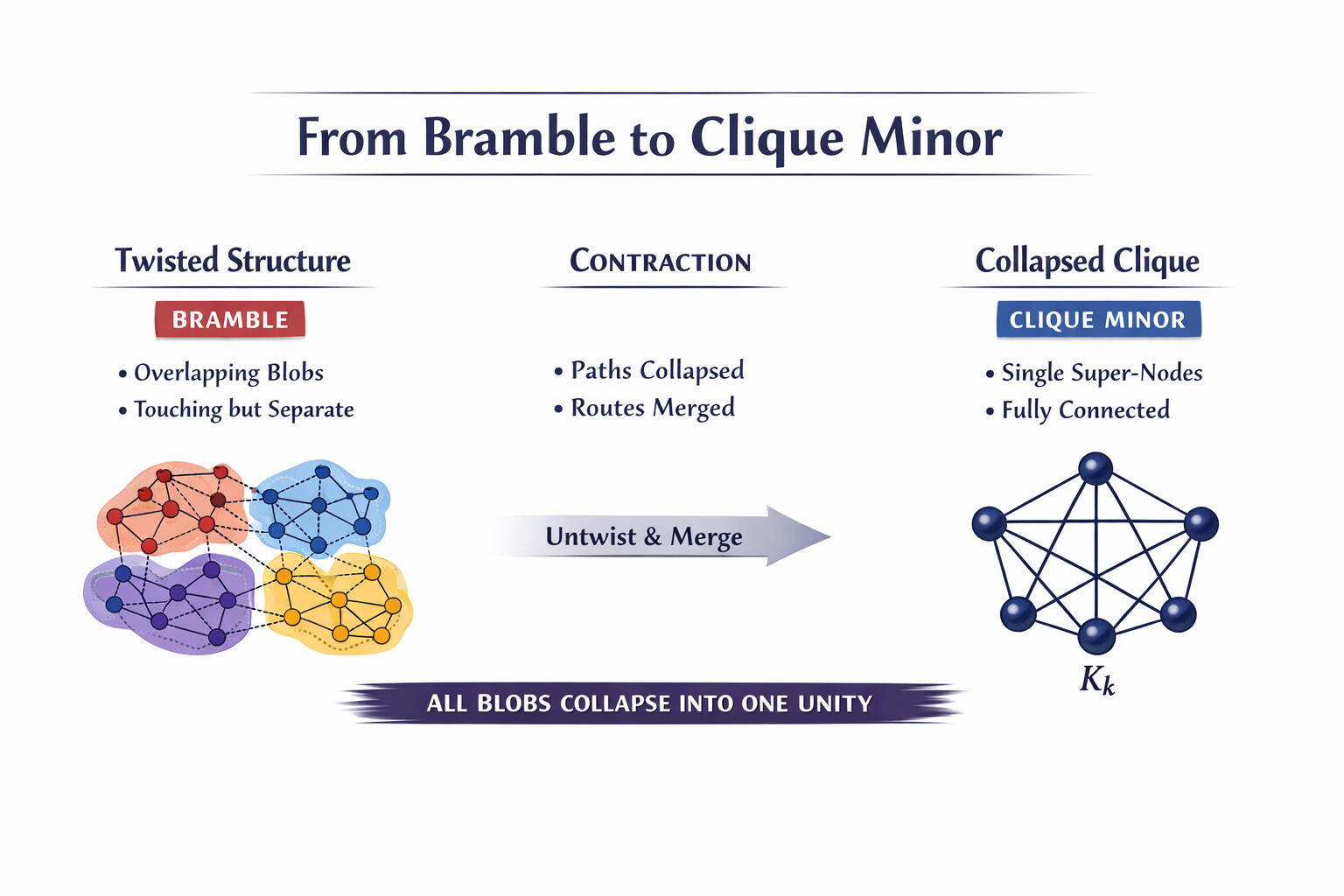
A cross-domain collapse pattern in which systems characterised by overlapping, flexible structures (brambles) fail when prematurely contracted into rigid, fully connected states (clique minors).
1) What’s recorded (Observed)
- Graph theory: brambles and clique minors as formal constructs
- Sudden loss of flexibility following forced contraction in mathematical systems
- Cognitive overload events where multiple options collapse into binary decisions
- Institutional and governance failures following premature resolution
- Physical analogues such as rope snaps and brittle material failures
2) Core pattern (Bramble shape)
Accumulation: Growing complexity, options, and interacting pathways
Bramble: Overlapping partial structures that touch without merging
Threshold: External or internal pressure forces contraction
Release/Collapse: Rapid simplification into a rigid, fully connected state
After-state: Reduced adaptability and increased brittleness
3) Forces / constraints
- Capacity limits (cognitive, structural, computational)
- Pressure to resolve ambiguity
- Loss of redundancy through contraction
- Demand for certainty or final answers
- Structural limits on maintaining overlap
4) Predictions
- Collapse events are sudden rather than gradual
- Post-collapse systems exhibit reduced flexibility
- Forcing resolution earlier increases likelihood of failure
- Systems allowed to remain brambled longer exhibit greater resilience
5) Falsifiers
- Systems that increase adaptability after forced contraction
- Stable clique structures that retain long-term flexibility
- Evidence that ambiguity removal consistently improves system resilience
6) Risks & safeguards (MAGG governance)
Pressure risk: Treating ambiguity as error rather than a holding state
Misread risk: Confusing collapse with correctness or success
Stop rule: If resolution increases harm or brittleness, revert to bramble state
Status: Active
Last updated: 2026
MAGG-LI-003: Rope Helix Snap as a Torsional Threshold Archetype
MAGG-LI-003: Rope Helix Snap as a Torsional Threshold Archetype
Domain: Physics / Mechanical Systems
Current State Tag(s): Observed · Modelled · Analogy · Threshold Signal
One-line description:
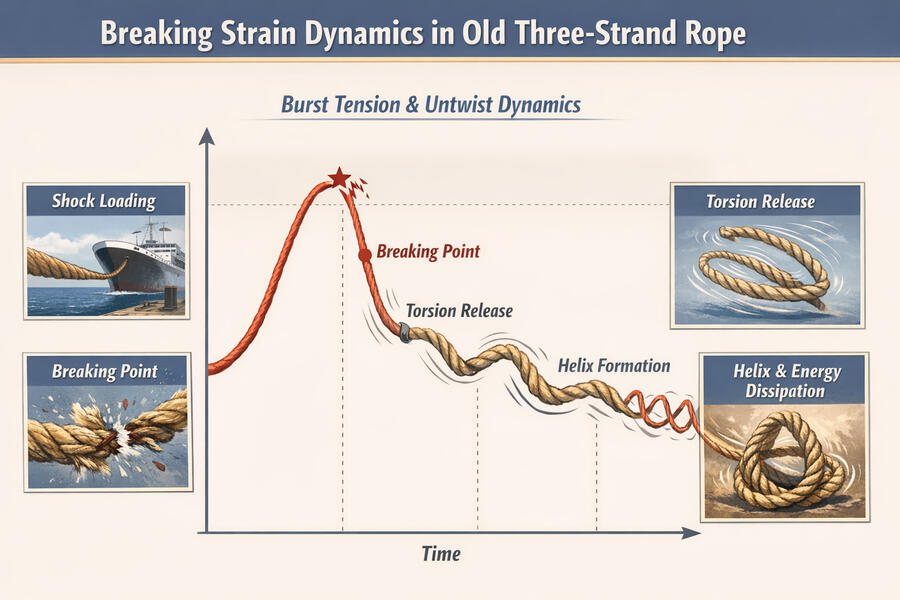
Failure of twisted fibrous systems in which stored torsional and tensile energy is released abruptly once a critical strain threshold is exceeded, producing helical recoil and rapid energy redistribution.
1) What’s recorded (Observed)
- Historical and practical observations of rope failure, particularly in older three-strand hemp ropes
- Sudden snapping accompanied by rapid recoil, looping, and helical motion
- Audible crack or snap coincident with release
- Residual twist and deformation in remaining rope sections
- Increased incidence under moisture, age, and uneven loading
2) Core pattern (Bramble shape)
Accumulation: Progressive storage of tensile load and torsional twist across braided strands
Bramble: Overlapping load paths within the braided structure distribute stress
Threshold: Localised breaking strain exceeded in one or more fibres
Release/Collapse: Rapid untwisting and recoil as torsional energy is freed
After-state: Simpler configuration with reduced stored energy
3) Forces / constraints
- Tensile force applied along rope length
- Torsional energy stored by twist and braid
- Material properties (fibre type, age, moisture content)
- Friction and interaction between strands
- Conservation of energy during release
4) Predictions
- Snapping events will preferentially produce helical or looping recoil rather than linear separation
- Greater braid complexity correlates with higher torsional energy storage
- Older or wetter ropes exhibit lower breaking thresholds and more dramatic recoil
- Energy release occurs over milliseconds rather than gradually
5) Falsifiers
- Rope systems under high torsion that fail without recoil or untwisting
- Demonstration that torsional energy plays no role in snap dynamics
- Consistent linear separation under high twist conditions
6) Risks & safeguards (MAGG governance)
Pressure risk: Oversimplifying the event as purely tensile failure
Misread risk: Treating mechanical analogy as explanatory beyond physical limits
Stop rule: If torsion cannot be shown to contribute materially, downgrade analogy use
Status: Active
Last updated: 2026
MAGG-LI-004: Fast Radio Bursts as Threshold Release Events
Domain: Astrophysics / Space
Current State Tag(s): Observed · Speculative · Threshold Signal · Unsafe to Collapse
One-line description:
Extremely energetic, millisecond-duration radio bursts interpreted as sudden releases from astrophysical systems that have exceeded a critical stability threshold, rather than as continuous or repeatable emission engines.
1) What’s recorded (Observed)
- Detection of fast radio bursts (FRBs) with millisecond durations
- Extremely high inferred energy output
- Some sources repeat, many are one-off events
- Often weak or absent persistent electromagnetic counterparts
- Events distributed across cosmological distances
2) Core pattern (Bramble shape)
Accumulation: Progressive build-up of energy, pressure, or field stress within a compact system
Bramble: Competing containment mechanisms (gravitational, magnetic, plasma) hold balance
Threshold: Stability limit exceeded under accumulated stress
Release/Collapse: Sudden, intense radio burst emitted
After-state: System either altered (repeaters) or silent (one-off events)
3) Forces / constraints
- Gravitational compression
- Magnetic field strength
- Plasma density and dynamics
- Energy containment limits
- Conservation laws governing burst emission
4) Predictions
- One-off FRBs leave no repeatable emission signature
- Repeaters indicate managed dissipation rather than terminal collapse
- Burst properties cluster near physical stability limits
- No universal periodicity across all FRB sources
5) Falsifiers
- A single mechanism explaining all FRBs with consistent repetition
- Universal periodic behaviour across the FRB population
- Evidence that bursts are sustained engines rather than threshold events
6) Risks & safeguards (MAGG governance)
Pressure risk: Over-attributing exotic or singular causes
Misread risk: Treating bursts as engines rather than failure events
Stop rule: If claims exceed current observational constraints, hold at speculative status
Status: Active (Speculative)
MAGG-LI-005: Marine Impact Buffering & RNA-Dominant Survivability (Architecture-Only Model)
Domain: Biology / Astrobiology / Earth Systems
Current State Tag(s): Speculative · Analogy · Unsafe to Collapse
One-line description:
An exploratory, architecture-only framework examining whether RNA-dominant, bramble-like proto-biological systems would exhibit enhanced survivability through fragmentation, space transit, and marine impact buffering, without asserting specific origins or lineages.
1) What’s recorded (Observed)
- Organic molecules (e.g., amino acids, nucleobases) identified in multiple meteorites
- Laboratory and ISS experiments demonstrating limited microbial survival under vacuum, radiation, and shock
- Confirmed and inferred marine impact events with incomplete crater records due to oceanic recycling
- Early Earth oceans provided thermal, chemical, and mechanical buffering environments
- Cephalopods display unusually high RNA editing and decentralised neural architectures
- No direct fossil, isotopic, or genetic evidence of extraterrestrial biological delivery
2) Core pattern (Bramble shape)
Accumulation: Complex chemistry and proto-biological systems arise in wet, energy-rich environments
Bramble: Distributed, modular RNA-dominant architectures tolerate damage, dormancy, and partial loss
Threshold: Fragmentation event (ejection/impact) selects against brittle, centralised systems
Release/Collapse: Majority of structures fail during transit or impact
After-state: Surviving architectures integrate into a new environment and undergo local evolution
3) Forces / constraints
- Thermal buffering provided by water during impact
- Shock dispersion in marine environments
- Radiation exposure and dormancy limits during transit
- RNA tolerance for mutation, damage, and repair
- Long geological timescales allowing selection rather than preservation
4) Predictions
- Survivability favours architecture (modularity, redundancy) over specific lineage
- Any delivered systems would rapidly lose distinguishable origin markers through local evolution
- Marine environments are significantly more permissive to impact survivability than land environments
- RNA-heavy strategies may re-emerge independently under extreme selection pressures
5) Falsifiers
- Demonstration that RNA-dominant adaptability cannot arise via Earth-only evolutionary processes
- Evidence that marine impacts universally sterilise biological material
- Empirical proof that RNA systems are less survivable than DNA systems under fragmentation and shock
6) Risks & safeguards (MAGG governance)
Pressure risk: Narrative drift toward origin claims or lineage assertions
Misread risk: Treating cephalopods or modern organisms as evidence rather than analogy
Stop rule: Maintain classification as speculative; park if narrative outruns evidence
Status: Active (Speculative, Architecture-Only)
MAGG-LI-006: Rogue Waves as Threshold-Bound Oceanic Bramble Events
Domain: Physics / Oceanography
Current State Tag(s): Observed · Modelled · Threshold Signal
One-line description:
Rare, extreme ocean waves emerging from the temporary alignment of multiple wave systems, collapsing once constructive interference thresholds are crossed.
1) What’s recorded (Observed)
- Instrument-confirmed rogue waves (e.g. Draupner wave, 1995)
- Sudden appearance, short duration
- Heights far exceeding surrounding sea state
- Historically dismissed until direct measurement
2) Core pattern (Bramble shape)
Accumulation: Multiple wave trains with differing directions, speeds, and phases
Bramble: Overlapping wave interactions without a dominant driver
Threshold: Constructive interference crosses stability limit
Release/Collapse: Single extreme wave forms and dissipates rapidly
After-state: Sea returns to statistically normal conditions
3) Forces / constraints
- Wave phase alignment
- Nonlinear wave interactions
- Wind input
- Current gradients
- Energy redistribution (no new energy source)
4) Predictions
- Rogue waves cluster in regions with complex currents
- Events are non-repeatable at fixed locations
- Forecasting improves by tracking interactions rather than averages
5) Falsifiers
- Proof rogue waves require a single dominant mechanism
- Stable, repeatable rogue wave generation at fixed points
6) Risks & safeguards (MAGG governance)
Pressure risk: Treating rogue waves as random noise
Misread risk: Over-reliance on linear wave models
Stop rule: Do not claim predictability without real-time interaction data
Status: Active
Last updated: 2026
MAGG-LI-007: Cognitive Overload & Burnout as Bramble Threshold Collapse
Domain: Cognitive Science / Human Systems
Current State Tag(s): Observed · Modelled · Analogy · Threshold Signal · Unsafe to Collapse
One-line description:
A system-level interpretation of cognitive overload and burnout as threshold collapse events arising when overlapping demands, signals, and responsibilities exceed human regulatory capacity.
1) What’s recorded (Observed)
- Widespread clinical and occupational reports of burnout and overload
- Sudden performance collapse after prolonged high-functioning periods
- Cognitive narrowing, decision paralysis, or abrupt withdrawal
- Physiological correlates: sleep disruption, cortisol dysregulation, fatigue
- Recovery often requires reduction of inputs rather than skill increase
2) Core pattern (Bramble shape)
Accumulation: Increasing tasks, expectations, emotional load, and uncertainty
Bramble: Overlapping roles and demands that cannot be cleanly separated
Threshold: Regulatory capacity exceeded (attention, energy, meaning)
Release/Collapse: Shutdown, burnout, disengagement, or crisis
After-state: Reduced capacity with potential long-term sensitivity
3) Forces / constraints
- Finite attentional and emotional capacity
- Time pressure and ambiguity
- Lack of recovery or buffering periods
- Social and institutional demand stacking
- Biological stress-response limits
4) Predictions
- Collapse is non-linear and often sudden
- Increasing efficiency alone does not prevent burnout
- Systems that preserve ambiguity and pacing reduce collapse risk
- Recovery requires removing inputs, not adding coping layers
5) Falsifiers
- Demonstration that unlimited cognitive load can be sustained without degradation
- Evidence that burnout resolves solely through skill optimisation
- Stable long-term performance under continuously increasing demand
6) Risks & safeguards (MAGG governance)
Pressure risk: Moralising burnout as individual failure
Misread risk: Using the model to justify excessive load
Stop rule: If applied prescriptively to increase pressure, classification must be downgraded
Status: Active (Unsafe to Collapse)
MAGG-LI-008: Market Crashes as Bramble Threshold Collapse Events
Domain: Economics / Complex Systems
Current State Tag(s): Observed · Modelled · Analogy · Threshold Signal · Unsafe to Collapse
One-line description:
A system-level interpretation of financial market crashes as threshold collapse events arising from the interaction of overlapping incentives, information delays, leverage, and behavioural feedback, rather than from single triggering causes.
1) What’s recorded (Observed)
- Historical market crashes (e.g., 1929, 1987, 2008, 2020)
- Sudden, non-linear price collapses following long periods of apparent stability
- Disproportionate reactions to relatively small triggering events
- Contagion effects across markets and geographies
- Post-crash narratives often disagree on the primary cause
2) Core pattern (Bramble shape)
Accumulation: Growing leverage, interconnected positions, optimism, and complexity
Bramble: Overlapping financial instruments, incentives, and information pathways
Threshold: Loss of confidence or liquidity pushes the system past stability limits
Release/Collapse: Rapid sell-offs, liquidity evaporation, and price cascades
After-state: Simplified market structure with reduced participation and risk appetite
3) Forces / constraints
- Leverage and margin requirements
- Information asymmetry and delays
- Behavioural feedback (fear, herding)
- Liquidity constraints
- Regulatory and institutional buffers
4) Predictions
- Crashes are sudden rather than gradual
- The apparent trigger is often insufficient to explain the scale of collapse
- Increasing interconnectedness raises systemic fragility
- Stabilisation requires reducing overlap and leverage, not restoring confidence alone
5) Falsifiers
- Evidence that crashes scale linearly with triggering events
- Markets that increase complexity and leverage yet become more stable
- Reliable long-term prevention of crashes through single-policy interventions
6) Risks & safeguards (MAGG governance)
Pressure risk: Using the model to justify deregulation or fatalism
Misread risk: Treating crashes as unavoidable natural events
Stop rule: If model is used to remove accountability, downgrade or park
Status: Active (Unsafe to Collapse)
MAGG-LI-009: Ecological Tipping Points as Multi-Stressor Bramble Collapse
Domain: Ecology / Earth Systems
Current State Tag(s): Observed · Modelled · Threshold Signal · Unsafe to Collapse
One-line description:
Abrupt, often irreversible ecosystem shifts arising when multiple interacting stressors collectively exceed resilience thresholds, rather than from a single dominant cause.
1) What’s recorded (Observed)
- Documented regime shifts (coral reef collapse, lake eutrophication, savannah–forest transitions)
- Sudden changes following long periods of apparent stability
- Hysteresis: systems do not return to prior states when stressors are reduced
- Early-warning signals observed in some systems (variance, autocorrelation)
- Disagreement over singular causes in post-collapse analyses
2) Core pattern (Bramble shape)
Accumulation: Gradual increase in temperature, nutrient load, extraction, or habitat fragmentation
Bramble: Overlapping biological, chemical, and physical interactions buffer change
Threshold: Combined stressors exceed resilience capacity
Release/Collapse: Rapid shift to an alternative stable state
After-state: New regime persists even if original pressures are eased
3) Forces / constraints
- Species interactions and feedback loops
- Energy and nutrient flows
- Climate variability
- Spatial connectivity and fragmentation
- Time delays in ecological response
4) Predictions
- Collapse is abrupt relative to rate of stress accumulation
- Reversal requires greater intervention than prevention
- Monitoring interaction effects outperforms single-metric thresholds
- Systems with higher diversity exhibit greater bramble buffering
5) Falsifiers
- Ecosystems that degrade and recover smoothly without thresholds
- Evidence that single stressors reliably predict collapse
- Universal early-warning indicators that prevent all regime shifts
6) Risks & safeguards (MAGG governance)
Pressure risk: Using inevitability narratives to justify inaction
Misread risk: Treating tipping points as precise triggers rather than zones
Stop rule: If model removes agency or accountability, downgrade or park
Status: Active (Unsafe to Collapse)
Last updated: 2026
MAGG-LI-010: AI System Failure as Bramble-to-Collapse Mismanagement
Domain: AI Systems / Safety / Human–Machine Interaction
Current State Tag(s): Observed · Modelled · Analogy · Threshold Signal · Unsafe to Collapse
One-line description:
Failures in AI systems arising not from single bugs, but from the mismanagement of overlapping objectives, constraints, feedback loops, and human expectations that collectively exceed system and governance capacity.
1) What’s recorded (Observed)
- High-profile AI failures caused by interaction effects rather than isolated errors
- Emergent behaviours from objective misalignment and reward hacking
- Performance cliffs when systems are scaled or deployed beyond tested contexts
- Human over-reliance following periods of apparent stability
- Post-incident analyses identifying multiple contributing factors
2) Core pattern (Bramble shape)
Accumulation: Increasing objectives, constraints, integrations, and deployment pressures
Bramble: Overlapping goals, feedback loops, and human–system dependencies
Threshold: Combined complexity exceeds oversight, interpretability, or control capacity
Release/Collapse: Sudden failure, misuse, or loss of trust
After-state: Retrenchment, restriction, or reactive governance
3) Forces / constraints
- Objective functions and reward structures
- Data distribution shifts
- Human–AI coupling and trust calibration
- Interpretability and monitoring limits
- Organisational and regulatory capacity
4) Predictions
- Failures will cluster at scale-up and deployment boundaries
- Single-fix solutions will be insufficient
- Systems with explicit bramble-holding mechanisms degrade more gracefully
- Governance failure often precedes technical failure
5) Falsifiers
- AI systems that scale indefinitely without new failure modes
- Reliable prevention of emergent failures through single-metric optimisation
- Complete elimination of misuse risk via technical controls alone
6) Risks & safeguards (MAGG governance)
Pressure risk: Treating failures as purely technical and ignoring human coupling
Misread risk: Using inevitability narratives to justify unsafe deployment
Stop rule: If complexity outpaces oversight, pause deployment and reintroduce bramble buffers
Status: Active (Unsafe to Collapse)
Last updated: 2026
MAGG-LI-011: Wildfire Escalation as Fuel–Weather Bramble Threshold Collapse
Domain: Ecology / Physics / Emergency Systems
Current State Tag(s): Observed · Modelled · Threshold Signal · Unsafe to Collapse
One-line description:
Rapid wildfire escalation arising when overlapping fuel loads, weather conditions, terrain, and suppression limits collectively exceed containment capacity, producing sudden, non-linear fire behaviour.
1) What’s recorded (Observed)
- Sudden transition from controllable fires to extreme fire behaviour
- Fire-generated weather, spotting, and rapid front expansion
- Historical megafires with abrupt escalation phases
- Ineffectiveness of suppression once critical thresholds are crossed
- Post-incident analyses identifying multiple interacting contributors
2) Core pattern (Bramble shape)
Accumulation: Fuel build-up, drought, heat, wind alignment, and terrain effects
Bramble: Overlapping drivers buffer growth while increasing latent risk
Threshold: Combined conditions exceed suppression and containment capacity
Release/Collapse: Explosive fire growth, crown fires, firestorms
After-state: Landscape reset with long-term ecological and social impacts
3) Forces / constraints
- Fuel moisture and continuity
- Wind speed and direction
- Topography and slope
- Atmospheric stability
- Suppression resources and response time
4) Predictions
- Escalation is sudden relative to rate of fuel accumulation
- Extreme behaviour clusters during rare weather alignments
- Early suppression effectiveness drops sharply near thresholds
- Prevention focuses on reducing overlap rather than single factors
5) Falsifiers
- Fires that escalate smoothly without thresholds
- Reliable containment under extreme multi-factor alignment
- Evidence that single-variable control prevents all megafires
6) Risks & safeguards (MAGG governance)
Pressure risk: Using inevitability framing to justify inaction
Misread risk: Treating fire behaviour as purely stochastic
Stop rule: If model is used to reduce preparedness or accountability, downgrade or park
Status: Active (Unsafe to Collapse)
MAGG-LI-012: Power Grid Blackouts as Cascading Bramble Threshold Failures
Domain: Infrastructure / Energy Systems
Current State Tag(s): Observed · Modelled · Threshold Signal · Unsafe to Collapse
One-line description:
Large-scale power grid blackouts arising from cascading failures when overlapping load, generation constraints, network topology, and protection systems collectively exceed stability margins.
1) What’s recorded (Observed)
- Major blackout events (e.g., 2003 North America, 2012 India, 2021 Texas)
- Cascading outages following initial local disturbances
- Non-linear spread of failure across interconnected regions
- Protection systems triggering further disconnections
- Post-event analyses identifying multiple interacting causes
2) Core pattern (Bramble shape)
Accumulation: Rising demand, ageing infrastructure, tight operating margins
Bramble: Interconnected generation, transmission, protection, and market operations
Threshold: Loss of synchrony or reserve capacity
Release/Collapse: Cascading line trips and system-wide blackout
After-state: Partial restoration with reduced stability and public trust
3) Forces / constraints
- Load variability and peak demand
- Generation reserve margins
- Network topology and bottlenecks
- Protection relay settings
- Human operator response times
4) Predictions
- Blackouts escalate rapidly once reserves fall below critical thresholds
- Increasing interconnection without buffering raises cascade risk
- Restoration is slower than failure onset
- Preventive measures focus on redundancy and margin, not efficiency alone
5) Falsifiers
- Grids that experience smooth degradation without cascading collapse
- Evidence that efficiency optimisation alone improves blackout resilience
- Universal prevention of cascades through single protective measures
6) Risks & safeguards (MAGG governance)
Pressure risk: Treating blackouts as rare anomalies
Misread risk: Using efficiency narratives to justify margin reduction
Stop rule: If reliability is sacrificed for optimisation, reintroduce bramble buffers
Status: Active (Unsafe to Collapse)
MAGG-LI-013: Urban Traffic Gridlock as Phase-Transition Bramble Collapse
Domain: Transportation / Urban Systems / Physics
Current State Tag(s): Observed · Modelled · Threshold Signal · Unsafe to Collapse
One-line description:
Sudden onset of urban traffic gridlock arising when overlapping flows, constraints, and behavioural feedbacks push a road network past a critical density threshold, producing a phase transition from flow to jam.
1) What’s recorded (Observed)
- Abrupt transitions from moving traffic to standstill without accidents
- Phantom traffic jams forming and propagating backward
- Empirical fundamental diagrams showing critical density thresholds
- Non-linear congestion during peak demand periods
- Recovery often slower than onset
2) Core pattern (Bramble shape)
Accumulation: Increasing vehicle density and route overlap
Bramble: Interacting flows, signals, merges, and driver behaviours
Threshold: Critical density exceeded on key links
Release/Collapse: Phase transition to stop-and-go waves or gridlock
After-state: Persistent congestion until density is reduced
3) Forces / constraints
- Road capacity and topology
- Signal timing and coordination
- Driver reaction times and heterogeneity
- Incidents and micro-disturbances
- Demand elasticity and route choice
4) Predictions
- Gridlock can emerge without accidents or bottlenecks
- Small disturbances can trigger large-scale jams near critical density
- Managing overlap and demand prevents collapse better than adding capacity
- Once collapsed, recovery requires density reduction
5) Falsifiers
- Traffic systems that degrade smoothly without phase transitions
- Universal prevention of jams via capacity expansion alone
- Absence of backward-propagating waves in dense traffic
6) Risks & safeguards (MAGG governance)
Pressure risk: Treating congestion as purely individual driver fault
Misread risk: Using the model to justify endless road expansion
Stop rule: If solutions increase overlap and density, reassess
Status: Active (Unsafe to Collapse)
MAGG-LI-014: Supply-Chain Shocks as Bramble-to-Cascade Threshold Events
Domain: Logistics / Economics / Global Systems
Current State Tag(s): Observed · Modelled · Threshold Signal · Unsafe to Collapse
One-line description:
Abrupt breakdowns in supply chains arising when overlapping dependencies, just-in-time buffers, information delays, and external shocks collectively exceed resilience capacity, producing cascading shortages.
1) What’s recorded (Observed)
- Widespread shortages following localized disruptions (e.g., ports, factories, transport)
- Non-linear propagation of delays across sectors and regions
- Bullwhip effects amplifying small demand or supply changes
- Recovery taking longer than initial disruption
- Post-event analyses citing multiple interacting causes
2) Core pattern (Bramble shape)
Accumulation: Increasing interdependence, efficiency optimization, and reduced inventory buffers
Bramble: Overlapping supplier relationships, logistics routes, and information flows
Threshold: Loss of slack or synchrony across key nodes
Release/Collapse: Cascading failures, shortages, and delays
After-state: Simplified networks with higher costs and reduced availability
3) Forces / constraints
- Inventory levels and buffer policies
- Transportation capacity and bottlenecks
- Information accuracy and latency
- Demand variability
- Geopolitical and environmental disruptions
4) Predictions
- Highly optimized chains are more fragile to shocks
- Small disruptions can trigger global effects near thresholds
- Recovery requires rebuilding buffers and redundancy
- Visibility across layers reduces collapse risk
5) Falsifiers
- Supply chains that maintain efficiency and resilience without buffers
- Linear propagation of disruptions without amplification
- Universal prevention of cascades through single-point fixes
6) Risks & safeguards (MAGG governance)
Pressure risk: Treating shortages as isolated failures
Misread risk: Using efficiency metrics to justify further buffer removal
Stop rule: If resilience is traded for cost savings, reintroduce bramble buffers
Status: Active (Unsafe to Collapse)
MAGG-LI-015: Social Media Virality as Attention Bramble Threshold Collapse
Domain: Information Systems / Sociology / Cognitive Systems
Current State Tag(s): Observed · Modelled · Analogy · Threshold Signal · Unsafe to Collapse
One-line description:
Sudden large-scale spread of content arising when overlapping attention dynamics, network structure, emotional resonance, and algorithmic amplification collectively exceed a visibility threshold, producing rapid, non-linear virality.
1) What’s recorded (Observed)
- Rapid, unpredictable content explosions across platforms
- Large reach triggered by relatively small initial events
- Strong emotional or identity-linked content overrepresented
- Platform-specific amplification effects
- Post-viral decay often faster than growth
2) Core pattern (Bramble shape)
Accumulation: Growing attention, shares, reactions, and algorithmic signals
Bramble: Overlapping social networks, emotions, identities, and recommendation systems
Threshold: Visibility crosses algorithmic and social amplification limits
Release/Collapse: Explosive spread followed by saturation or backlash
After-state: Attention collapse, reputational shifts, or norm changes
3) Forces / constraints
- Network topology and clustering
- Algorithmic ranking and feedback loops
- Human attention limits
- Emotional salience and novelty
- Platform moderation and friction mechanisms
4) Predictions
- Virality is non-linear and difficult to engineer reliably
- Small changes near thresholds produce large effects
- Dampening overlap reduces runaway spread
- Post-viral states often involve trust or norm recalibration
5) Falsifiers
- Reliable linear scaling of reach with input effort
- Universal virality formulas independent of network context
- Stable attention growth without collapse or saturation
6) Risks & safeguards (MAGG governance)
Pressure risk: Using virality models to manipulate or exploit audiences
Misread risk: Treating virality as merit rather than threshold artifact
Stop rule: If applied to bypass consent or amplify harm, downgrade or park
Status: Active (Unsafe to Collapse)
MAGG-LI-016: Creativity Flow States as Bramble-Stabilised Cognitive Dynamics
Domain: Creativity / Cognitive Science / Human Performance
Current State Tag(s): Observed · Modelled · Analogy · Threshold Signal · Unsafe to Collapse
One-line description:
Creativity and flow states interpreted as temporarily stabilised cognitive brambles, where overlapping ideas, skills, affect, and feedback are held in balance, collapsing when pressure, interruption, or over-evaluation exceeds tolerance.
1) What’s recorded (Observed)
- Self-reports and experimental studies of flow states
- Heightened focus with reduced self-monitoring
- Non-linear productivity bursts followed by fatigue
- Sensitivity to interruption and evaluation
- Post-flow drop-off or integration phase
2) Core pattern (Bramble shape)
Accumulation: Skills, ideas, motivation, and contextual cues align
Bramble: Multiple cognitive threads overlap without premature selection
Threshold: External pressure or internal evaluation intrudes
Release/Collapse: Flow breaks into distraction, anxiety, or exhaustion
After-state: Reduced intensity with consolidation or recovery
3) Forces / constraints
- Attentional bandwidth
- Emotional regulation
- Task difficulty–skill balance
- Environmental interruption
- Social evaluation pressure
4) Predictions
- Flow emerges non-linearly once multiple conditions align
- Excess monitoring degrades performance near thresholds
- Holding ambiguity longer sustains creative output
- Recovery phases are required to re-enter flow
5) Falsifiers
- Linear relationship between effort and creative output
- Flow states unaffected by interruption or evaluation
- Sustained peak creativity without recovery
6) Risks & safeguards (MAGG governance)
Pressure risk: Instrumentalising creativity for extraction
Misread risk: Treating flow as constant productivity state
Stop rule: If applied to increase pressure or surveillance, downgrade or park
Status: Active (Unsafe to Collapse)
MAGG-LI-017: Health System Overload as Care-Capacity Bramble Collapse
Domain: Healthcare / Public Systems / Emergency Response
Current State Tag(s): Observed · Modelled · Threshold Signal · Unsafe to Collapse
One-line description:
Health system failures arising when overlapping demand surges, staffing limits, resource constraints, and coordination burdens collectively exceed care capacity, producing abrupt degradation in service quality and outcomes.
1) What’s recorded (Observed)
- Sudden hospital overwhelm during epidemics, disasters, and heatwaves
- Non-linear drops in care quality once occupancy thresholds are exceeded
- Staff burnout, absenteeism, and moral injury
- Triage and care rationing introduced under pressure
- Recovery periods longer than surge onset
2) Core pattern (Bramble shape)
Accumulation: Rising patient load, chronic understaffing, administrative burden
Bramble: Interdependent care pathways, staff roles, logistics, and decision layers
Threshold: Care coordination and staffing capacity exceeded
Release/Collapse: Service degradation, delayed care, excess mortality
After-state: Reduced capacity, staff loss, and long-term system fragility
3) Forces / constraints
- Staffing ratios and skill mix
- Bed, ICU, and equipment availability
- Information flow and decision load
- Infection control and safety protocols
- Emotional and cognitive load on staff
4) Predictions
- Performance degrades sharply beyond occupancy thresholds
- Adding efficiency increases fragility near limits
- Early load reduction prevents later collapse
- Recovery requires restaffing and morale repair, not throughput optimisation
5) Falsifiers
- Systems that maintain quality under unlimited demand
- Linear relationship between load and outcomes
- Burnout resolved solely through process optimisation
6) Risks & safeguards (MAGG governance)
Pressure risk: Normalising overload as acceptable baseline
Misread risk: Using crisis performance to justify permanent austerity
Stop rule: If human limits are ignored, downgrade or park
Status: Active (Unsafe to Collapse)
MAGG-LI-018: Climate Feedback Loops as Multi-Layer Bramble Amplification
Domain: Climate Science / Earth Systems
Current State Tag(s): Observed · Modelled · Threshold Signal · Unsafe to Collapse
One-line description:
Climate system acceleration arising when overlapping feedback mechanisms (albedo loss, carbon release, circulation shifts, biosphere responses) mutually reinforce beyond buffering capacity, producing rapid, non-linear change.
1) What’s recorded (Observed)
- Measured amplification effects (Arctic amplification, permafrost thaw)
- Non-linear temperature responses to forcing
- Abrupt regional shifts in circulation and precipitation
- Lagged but accelerating biosphere responses
- Increasing difficulty attributing change to single drivers
2) Core pattern (Bramble shape)
Accumulation: Gradual forcing from greenhouse gas emissions and land-use change
Bramble: Overlapping physical, chemical, and biological feedbacks dampen or amplify change
Threshold: Feedback reinforcement overwhelms buffering mechanisms
Release/Collapse: Rapid state shift or acceleration beyond historical variability
After-state: New climatic regime with altered baselines and extremes
3) Forces / constraints
- Radiative forcing and energy balance
- Cryosphere extent and albedo
- Carbon cycle dynamics
- Ocean heat uptake and circulation
- Ecosystem resilience and response times
4) Predictions
- Change accelerates after prolonged apparent stability
- Regional thresholds precede global averages
- Interventions targeting single feedbacks are insufficient alone
- Delays mask proximity to thresholds
5) Falsifiers
- Linear climate response across all forcing ranges
- Absence of feedback amplification under increased forcing
- Stable long-term buffering regardless of feedback interaction
6) Risks & safeguards (MAGG governance)
Pressure risk: Framing collapse as inevitable, discouraging mitigation
Misread risk: Treating thresholds as precise tipping points
Stop rule: If model is used to justify inaction or despair, downgrade or park
Status: Active (Unsafe to Collapse)
MAGG-LI-019: Conflict Escalation as Signal–Response Bramble Collapse
Domain: Social Systems / Security Studies / Psychology
Current State Tag(s): Observed · Modelled · Analogy · Threshold Signal · Unsafe to Collapse
One-line description:
Rapid escalation of conflicts arising when overlapping signals, misperceptions, identity pressures, and retaliation dynamics collectively exceed de-escalation capacity, producing sudden, non-linear intensification.
1) What’s recorded (Observed)
- Conflicts that escalate abruptly following prolonged tension
- Disproportionate retaliation to relatively small triggering events
- Breakdown of communication channels near escalation points
- Role of misinterpretation, signalling errors, and time pressure
- Post-escalation narratives diverge on “who started it”
2) Core pattern (Bramble shape)
Accumulation: Grievances, fear, identity threat, and unresolved incidents
Bramble: Overlapping signals, alliances, deterrence postures, and narratives
Threshold: Perceived threat overwhelms trust and restraint mechanisms
Release/Collapse: Rapid escalation (violence, sanctions, mobilisation)
After-state: Hardened positions with reduced negotiation space
3) Forces / constraints
- Communication latency and ambiguity
- Identity and status dynamics
- Deterrence and retaliation doctrines
- Leadership decision bandwidth
- Domestic and international audience costs
4) Predictions
- Escalation is non-linear and clustered in time
- Misperception plays a larger role near thresholds than intent
- De-escalation capacity erodes before visible escalation
- Buffering signals and pauses reduce escalation probability
5) Falsifiers
- Conflicts that escalate smoothly and proportionally
- Reliable prediction of escalation from single indicators
- Stable deterrence without signalling ambiguity across all contexts
6) Risks & safeguards (MAGG governance)
Pressure risk: Using models to justify aggression or fatalism
Misread risk: Treating escalation as inevitable or rational
Stop rule: If model is used to legitimise harm, downgrade or park
Status: Active (Unsafe to Collapse)
MAGG-LI-020: Memory Formation & Forgetting as Stability–Plasticity Bramble Dynamics
Domain: Neuroscience / Cognitive Systems / Learning
Current State Tag(s): Observed · Modelled · Analogy · Threshold Signal · Unsafe to Collapse
One-line description:
Memory formation and forgetting interpreted as bramble-like dynamics balancing stability and plasticity, where overlapping neural traces are held long enough to consolidate, and collapse when interference, stress, or lack of reinforcement exceeds retention thresholds.
1) What’s recorded (Observed)
- Empirical evidence for consolidation windows and reconsolidation
- Forgetting curves showing non-linear decay
- Interference effects between similar memories
- Stress-dependent enhancement or impairment of memory
- Sleep and replay supporting consolidation
2) Core pattern (Bramble shape)
Accumulation: Repeated exposure, rehearsal, and emotional salience
Bramble: Overlapping neural representations and associations
Threshold: Interference, stress, or insufficient reinforcement disrupts consolidation
Release/Collapse: Memory weakens, fragments, or is overwritten
After-state: Simplified or altered memory trace
3) Forces / constraints
- Synaptic plasticity limits
- Neuromodulatory state (stress, arousal)
- Similarity-based interference
- Sleep quality and timing
- Cognitive load
4) Predictions
- Memory strength shows threshold behaviour rather than linear decay
- Interference near consolidation windows disproportionately impairs retention
- Spaced reinforcement preserves bramble stability
- Excessive stress collapses memory coherence
5) Falsifiers
- Linear forgetting without consolidation effects
- Absence of interference between similar memories
- Unlimited plasticity without stability trade-offs
6) Risks & safeguards (MAGG governance)
Pressure risk: Treating memory as a storage device rather than a dynamic system
Misread risk: Using models to justify coercive learning or erasure
Stop rule: If applied to manipulate memory or consent, downgrade or park
Status: Active (Unsafe to Collapse)